Local News Documentary irons out a life By Zach Spicer – 7/17/15 6:00 AM photo Submitted photo by Ed Krauter/ Giap Thi Byers, left, of Seymour stands with her son, Tony Nguyen, who now lives in Oakland, California. Nguyen directed the documentary “Giap’s Last Day at the Ironing Board Factory” that is a part of this year’s Indy Film Fest. Part of it was filmed in Seymour, where Byers worked at Home Products International Inc. SUBMITTED by Ed Krauter A few years ago, while visiting a farmers market in Oakland, California, Giap Thi Byers and her son, Tony Nguyen, went to a food stand that used ironing boards as dining tables. Byers went up to one of the ironing boards and looked at the underside, which piqued her son’s curiosity. “I walked over, and she looked at me and said, ‘I make these at work,’” said Nguyen, who was shocked by the news. “When I saw her inspecting the ironing board, it just dawned on me that I didn’t really know too much about my mother. I knew she worked in a factory, but I didn’t know exactly what kind of work she did.” That spurred Nguyen, a 39-year-old filmmaker, to document his mother’s story. It initially was going to be a video for him to share with family and friends and be a memento for his mother. But after he showed some of the footage to one of his mentors and award-winning filmmaker, Steven Okazaki, Nguyen was encouraged to make it a documentary. After gaining approval from his mother’s bosses, Nguyen flew from Oakland to Seymour a couple of years ago to film his mother’s last day of working on the assembly line at Home Products International Inc., which is the only ironing board factory remaining in America. “Giap’s Last Day at the Ironing Board Factory,” a half-hour documentary directed by Nguyen with producing and editing by Okazaki, will have its Midwest premiere at Indy Film Fest in Indianapolis as part of the Long Goodbye Short Films program. It will be shown at 11 a.m. Sunday and 6:30 p.m. Wednesday in the Deboest Lecture Hall at the Indianapolis Museum of Art. Byers, who still lives in Seymour, and Nguyen, who is flying in from Oakland, will attend the showing and answer questions at the end. The film also tells the story of how Byers, who was a Vietnamese refugee in 1975 when she fled the country after the fall of Saigon, ended up in Seymour. She was pregnant with her son at the time, and the film follows his childhood in Seymour.
It’s not easy raising a family. Much less so when your teenage daughter is dating. For Paul Hennessy’s offspring, you’d better remember these simple rules: 1. Use your hands on my daughter and you’ll lose them after. 2. You make her cry, I make you cry. 3. Safe sex is a myth. Anything you try will be hazardous to your health. 4. Bring her home late, there’s no next date. 5. If you pull into my driveway and honk, you better be dropping off a package because you’re sure not picking anything up (Alternative rule #5: Only delivery men honk. Dates ring the doorbell. Once.) 6. No complaining while you’re waiting for her. If you’re bored, change my oil. 7. If your pants hang off your hips, I’ll gladly secure them with my staple gun. 8. Dates must be in crowded public places. You want romance? Read a book. Any questions? An American TV sitcom which was previously known as 8 Simple Rules for Dating My Teenage Daughter, the title was subsequently shortened to 8 Simple Rules.
image Charley Gallay/Getty Images for Playboy For the last 40 years, the entertainment icon made his home in the infamous Playboy Mansion, the site of many a crazy party. Hefner never technically owned the Los Angeles estate. He leased it from Playboy Enterprises and paid $100 a year in rent. In August 2016, the nearly 20,000-square-foot house sold for $100 million to Daren Metropoulos, a principal of the private-equity firm Metropoulos & Co. and a former co-CEO of Pabst Brewing Company. As part of the terms of the sale, Hefner was allowed to continue living there for $1 million per year. Now that he has died, the mansion and its five-acre grounds will officially have no further ties to Playboy Enterprises. https://www.businessinsider.com/playboy-mansion-photos-of-hugh-hefner-home-2017-9 Billionaire’s Son Is Buying Playboy Mansion For A Reported $105 Million, About Half Its Listed Price Derek Xiao 25,009 viewsJun 10, 2016, 07:11pm The swimming pool at the Playboy Mansion in Holmby Hills, Los Angeles, California. (Photo credit) Frederic J. Brown The swimming pool at the Playboy Mansion in Holmby Hills, Los Angeles, California. (Photo credit Frederic J. Brown/AFP/Getty Images) Daren Metropoulos, the son of billionaire C. Dean Metropoulos, looks to have gotten a relative “deal” in his agreement to buy the Playboy Mansion. The mansion was put on the market six months ago for $200 million—one of the highest asking prices for a private residence in the United States. But it’s being sold for about half of its listed price, or $105 million, according to The Los Angeles Times. An unnamed source told the L.A. Times the sale price. The newspaper also says that the initial $200 million asking price may have been nothing more than a publicity stunt. A representative for Daren Metropoulos did not respond to a request for comment about the price. Even at the lower-than-asked-for price, the transaction will be the most expensive home sale ever recorded in Los Angeles County . The newspaper said the current record was set in 2014, when the 50,000-square-foot Westside mansion Fleur de Lys went for $102 million, a price that included artwork and furnishings. The 29-room Playboy Mansion, which gained notoriety over the years for the extravagant parties that have been hosted on its grounds, features a wine cellar, home theater, separate game house, gym, tennis court, separate four-bedroom guesthouse, official zoo license, and a freeform swimming pool with the famous cave-like grotto, according to the listing. As of late, however, the mansion—like the magazine with which it shares its name—has fallen on tougher times. Former playmates told Realtor.com that the once pristine estate is decrepit and marked by a strong smell of urine. The Playboy Mansion, though famously known as the home of Hefner, is technically not owned by the man, but rather Playboy Enterprises. As reported earlier this week, buyer Daren Metropoulos is the son of billionaire private equity mogul C. Dean Metropoulos, whose net worth FORBES pegs at $2.4 billion. The billionaire co-owns Hostess, the maker of Twinkies, with private equity firm Apollo Global Management. Over the years, he has bought, turned around and sold brands from Chef Boyardee to Pam cooking spray. The younger Metropoulos also happens to own the adjacent Holmby Hills property—a 7,300-square-foot English Manor-style house that he bought from longtime Playboy Mansion resident Hugh Hefner and his former wife Kimberly Conrad in 2009 for $18 million. The estate, which has five bedrooms and seven bathrooms, served as the personal residence to Hefner and his since-divorced wife before being sold to Metropoulos. Since buying the 1927 Gothic Tudor home adjacent to the Playboy Mansion, Daren Metropoulos has made significant restorations to the property. In particular, he renovated the formal gardens and expansive grounds that sit adjacent to the Los Angeles Country Club and include the original gate that connects to the Playboy Mansion. A representative for Metropoulos told Forbes earlier this week that once Hefner’s tenancy ends and the sale closes—which is a condition of the deal—the new owner plans on joining his current estate with the Playboy Mansion to create the 7.3-acre compound that the architect of both properties, Arthur R. Kelly, originally envisioned.
Star Trek: The Motion Picture (7/9) Movie CLIP – VGER is Voyager 6 (1979) HD
NASA’s Voyager 2 becomes 2nd Earth craft in interstellar space
The space probe is now beyond the influence of our sun
Default
Mono Sans
Mono Serif
Sans
Serif
Comic
Fancy
Small Caps
Default
Small
Medium
Large
X-Large
XX-Large
Default
Outline Dark
Outline Light
Outline Dark Bold
Outline Light Bold
Shadow Dark
Shadow Light
Shadow Dark Bold
Shadow Light Bold
Default
Black
Silver
Gray
White
Maroon
Red
Purple
Fuchsia
Green
Lime
Olive
Yellow
Navy
Blue
Teal
Aqua
Orange
Default
100%
75%
50%
25%
0%
Default
Black
Silver
Gray
White
Maroon
Red
Purple
Fuchsia
Green
Lime
Olive
Yellow
Navy
Blue
Teal
Aqua
Orange
Default
100%
75%
50%
25%
0%
Voyager 2 becomes 2nd craft in interstellar space
By Ed Payne|December 10, 2018 at 1:57 PM EST – Updated December 10 at 5:05 PM
(RNN) – For just the second time in history, a human-made object has reached interstellar space. That’s the area of the cosmos between the stars.
NASA’s Voyager 2 spacecraft accomplished that feat in early November, some 41 years after it was launched from Earth.
Its twin, Voyager 1, reached interstellar space in 2012. Both were launched from Cape Canaveral, FL, in 1977, but Voyager 2 followed a longer path away from Earth.
Description English: The “family portrait” of the Solar System taken by Voyager 1. This picture consists of 60 frames taken through the Wide Angle and Narrow Angle cameras using the Methane, Violet, Blue, Green, and Clear Filters. Suggested for English Wikipedia:alternative text for images: a set of grey squares trace roughly left to right. A few are labeled with single letters associated with a nearby coloured square. J is near to a square labeled Jupiter; E to Earth; V to Venus; S to Saturn; U to Uranus; N to Neptune. A small spot appears at the centre of each coloured square English: Original Caption Released with Image: The cameras of Voyager 1 on Feb. 14, 1990, pointed back toward the sun and took a series of pictures of the sun and the planets, making the first ever “portrait” of our solar system as seen from the outside. In the course of taking this mosaic consisting of a total of 60 frames, Voyager 1 made several images of the inner solar system from a distance of approximately 4 billion miles (6.4 billion kilometers) and about 32 degrees above the ecliptic plane. Thirty-nine wide angle frames link together six of the planets of our solar system in this mosaic. Outermost Neptune is 30 times further from the sun than Earth. Our sun is seen as the bright object in the center of the circle of frames. The wide-angle image of the sun was taken with the camera’s darkest filter (a methane absorption band) and the shortest possible exposure (1/125 second) to avoid saturating the camera’s vidicon tube with scattered sunlight. The sun is not large as seen from Voyager, only about one-fortieth of the diameter as seen from Earth, but is still almost 8 million times brighter than the brightest star in Earth’s sky, Sirius. The result of this great brightness is an image with multiple reflections from the optics in the camera. Wide-angle images surrounding the sun also show many artifacts attributable to scattered light in the optics. These were taken through the clear filter with one second exposures. The insets show the planets magnified many times. Narrow-angle images of Earth, Venus, Jupiter, Saturn, Uranus and Neptune were acquired as the spacecraft built the wide-angle mosaic. Jupiter is larger than a narrow-angle pixel and is clearly resolved, as is Saturn with its rings. Uranus and Neptune appear larger than they really are because of image smear due to spacecraft motion during the long (15 second) exposures. From Voyager’s great distance Earth and Venus are mere points of light, less than the size of a picture element even in the narrow-angle camera. Earth was a crescent only 0.12 pixel in size. Coincidentally, Earth lies right in the center of one of the scattered light rays resulting from taking the image so close to the sun. Date 14 February 1990 Source Visible Earth source: http://photojournal.jpl.nasa.gov/catalog/PIA00451 TIFF version: http://photojournal.jpl.nasa.gov/tiff/PIA00451.tif Author NASA, Voyager 1 Licensing Edit Public domain This file is in the public domain in the United States because it was solely created by NASA. NASA copyright policy states that “NASA material is not protected by copyright unless noted”. (See Template:PD-USGov, NASA copyright policy page or JPL Image Use Policy.) NASA logo.svg Dialog-warning.svg Warnings: Use of NASA logos, insignia and emblems is restricted per U.S. law 14 CFR 1221. The NASA website hosts a large number of images from the Soviet/Russian space agency, and other non-American space agencies. These are not necessarily in the public domain. Materials based on Hubble Space Telescope data may be copyrighted if they are not explicitly produced by the STScI.[1] See also {{PD-Hubble}} and {{Cc-Hubble}}. The SOHO (ESA & NASA) joint project implies that all materials created by its probe are copyrighted and require permission for commercial non-educational use. [2] Images featured on the Astronomy Picture of the Day (APOD) web site may be copyrighted. [3] The National Space Science Data Center (NSSDC) site has been known to host copyrighted content. Its photo gallery FAQ states that all of the images in the photo gallery are in the public domain “Unless otherwise noted.”
Description English: Position and trajectory of Voyager 1 and the positions of the planets on 14 February 1990, the day when Pale Blue Dot and Family Portrait were taken. Date 20 February 2018 Source Own work Author Joe Haythornthwaite and Tom Ruen Other versions This file was derived from: Pale blue dot feb14 1990 voyager-path.png: Pale blue dot feb14 1990 voyager-path.png Pale blue dot feb14 1990 voyager-path2.png: Pale blue dot feb14 1990 voyager-path2.png Licensing Edit w:en:Creative Commons attribution share alike This file is licensed under the Creative Commons Attribution-Share Alike 4.0 International license. You are free: to share – to copy, distribute and transmit the work to remix – to adapt the work Under the following conditions:
The Voyager spacecraft are on a long journey out of our solar system into interstellar space. Despite their great distance from Earth, we are still able to communicate with the spacecraft on a regular basis. This article looks at the basic communication infrastructure that allows us to communicate with the spacecraft.
Welcome to AAC’s series of articles celebrating the Voyager missions! Check out the other articles in the series to catch up:
This week, series coordinator Mark Hughes looks at the long-distance communications the Voyager craft are equipped with.
The Deep Space Network
After the Voyager spacecraft left Earth and completed their grand tour of the solar system, they began their journey into the regions of space that are beyond the influence of our sun—answering questions about what lies in the great cosmic void between stars.
Thirty-eight hours ago, a 20 kW signal was transmitted from Earth towards the Voyager 1 spacecraft. Nineteen hours ago, the signal was received by Voyager 1 and returned by a 20 Watt transponder. And, as I write this article, a station in Madrid, Spain is receiving that return signal at a power level of
9×10⁻²³kW=9×10⁻⁸pW
(-160.48 dBm.) For reference, a very good FM radio receiver can pick up signals at
9×10⁻⁵pW
, the signal received from Voyager is 1000 times weaker.
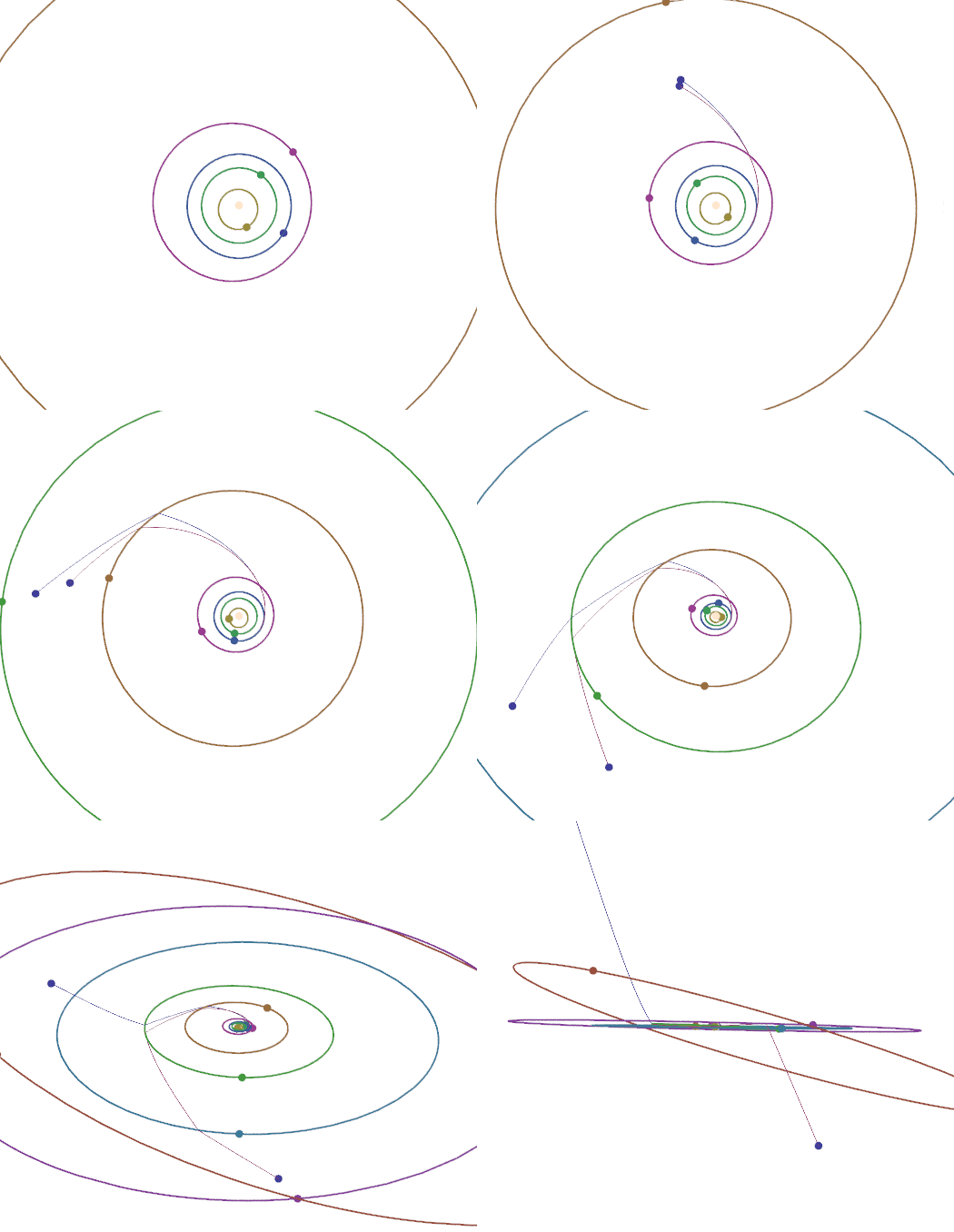
Accelerating Image showing the path of the Voyager spacecraft and the planets during its mission. Credit: Mark Hughes
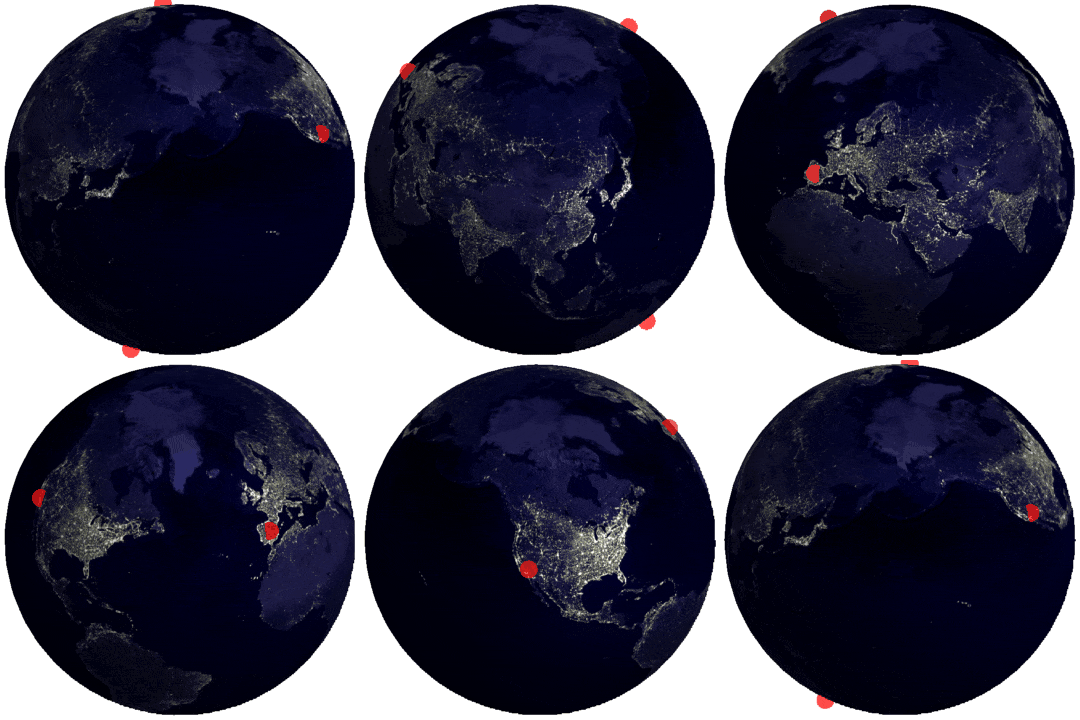
The Deep Space Network consists of three antenna complexes that are stationed around the globe approximately 120-longitudinal degrees apart. The global separation of stations allows most spacecraft to have an uninterrupted line-of-sight with at least one station regardless of the time of day. A listening station will rise before the last visible one sets. Voyager 1 is still visible from all three stations, but Voyager 2 is only visible from the Canberra, Australia site.
This spinning globe has red dots that represent Deep Space Network stations in: Canberra, Australia; Goldstone, California, United States; and Madrid, Spain. Credit: Mark Hughes
Watch which spacecraft the Deep Space Network antennas are communicating with below.
below.
Visit the full website: https://eyes.nasa.gov/dsn/dsn.html
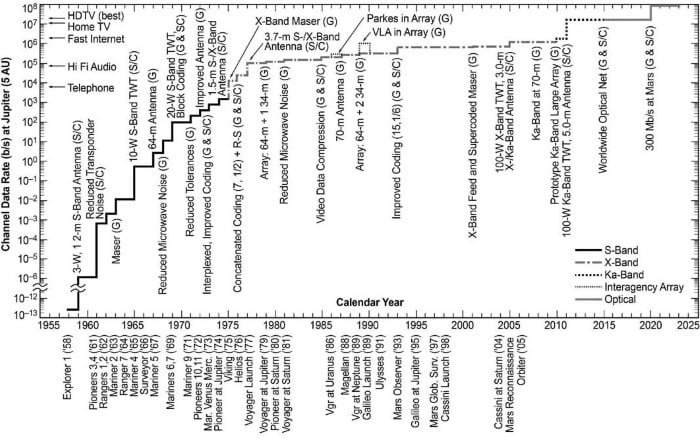
As the spacecraft travel further from Earth, the signal strength decreases due to free space path loss. Data rates typically fall as a consequence. Improvements in the Deep Space Network receiver sensitivity over the past 40 years have mitigated reductions in data rate.
Deep space network capabilities. Image credit: NASA.gov
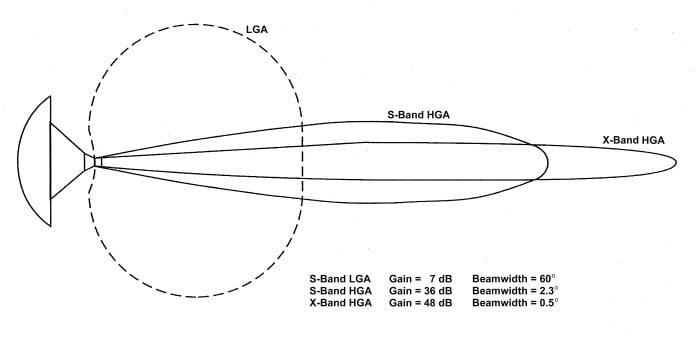
Due to the incredible weakness of the spacecraft’s downlink by the time it reaches Earth, large parabolic reflectors, and hyperbolic sub-reflectors collect the microwave radiation and focus it on a cryogenically cooled receiver at the base of the antenna.
Image of a microwave antenna from NASA.gov. Click here for a larger detailed image of the antenna.
Each Deep Space Network location has multiple 34-meter antennas and a single 70-meter antenna. While any one of the antennas is more than powerful enough to transmit to Voyager, a single 34-meter antenna does not collect enough electromagnetic radiation to detect Voyagers downlink. Antennas at each site can be linked to simultaneously receive the signal from the spacecraft, providing increased gain through radio interferometry.
Voyager 2 antenna tracking schedule for Canberra, Australia (click for larger) shows the large 70-meter antenna on the top row and the 34-meter antennas in the bottom three rows. Multiple antennas can be linked to increase gain. Credit: Mark Hughes
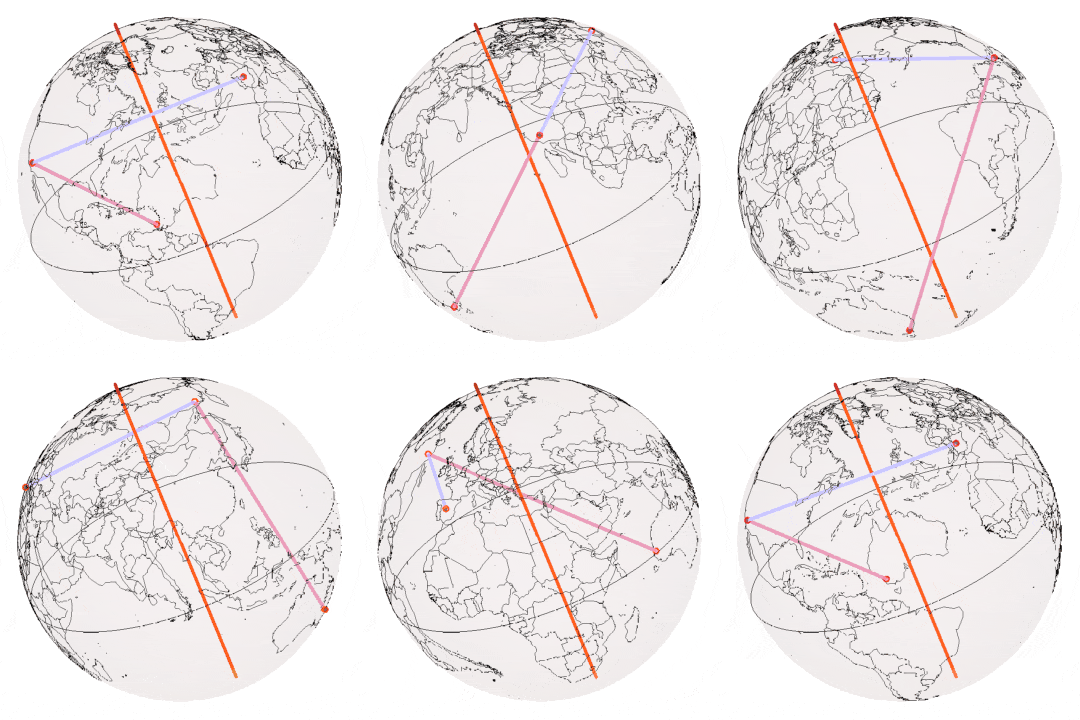
Accurately locating the spacecraft on its journey was accomplished with Doppler rangefinding, and later with Very Long Baseline Interferometry (VLBI) along two baselines that extend from Goldstone, California to Madrid, Spain, and from Goldstone, California to Canberra, Australia.
The Goldstone-Madrid baseline is used to determine right-ascension of a spacecraft and the Goldstone-Canberra baseline provides a mix between right-ascension and declination. When combined, the data can locate the spacecraft extremely accurately in the celestial sphere with angular measurement error measured in nano-radians (one nano-radian of error at 1 million kilometers is 100 cm).
Interferometer baselines from Goldstone to Madrid (Blue), and baseline from Goldstone to Canberra (Red). Credit: Mark Hughes
Each Deep Space Network site has a highly accurate frequency source that can be tuned to compensate for the Doppler frequency shift caused by relative movement between the transmitting and receiving antennas. Compensation takes into account the movement of the spacecraft, the rotation of the Earth around the sun, and the revolution of the Earth around its axis. Receivers are able to detect frequency shifts that are a fraction of a hertz.
The uplink carrier frequency of Voyager 1 is 2114.676697 MHz and 2113.312500 MHz for Voyager 2. The uplink carrier can be modulated with command and/or ranging data. Commands are 16-bps, Manchester-encoded, biphase-modulated onto a 512 HZ square wave subcarrier.
Manchester encoding (X0R) illustrated with a blue clock signal, orange data signal, and green result. Credit: Mark Hughes
Voyager’s receivers phase lock to the uplink carrier to provide a two-way coherent downlink carrier signal or can use an internal frequency source to produce a non-coherent downlink carrier. The spacecraft can return information to Earth with X-band or S-band transmitters
The Voyager spacecraft will continue their journey for unknown millennia, but we will only be able to communicate with them for another eight years—by that time, the Radionucleotide Thermoelectric Generators will have depleted to the point that they can no longer power Voyager’s remaining scientific instruments and transmitters. The spacecraft will fall silent.
Scientists at the Deep Space Network will track the downlink signal from the spacecraft as it sputters into silence and becomes part of the background noise of the solar system—never to be heard from by humans again.
Additional resources and references used to write this article can be found at:
though their details/paths might seem to differ, everything–including Thuyền viễn xứ–move toward the universal destination/goal of “you’re ok/well; i’m ok/well” “muôn loài được bình thường sống lâu; everyone live well and long” …
Greatest Thing You’ll Ever Learn Nat King Cole Nature Boy … dahlia or dominique was reading st antoine exupery world war ii regret story the little prince that father gifted them … woman in blue walking and reading at the same time today om way to 99 ranch to^nddi.nh also got them a book of stickers and they used a parrot sticker …
eden ahbez — who insisted that his name be spelled without capital letters, claiming that only “God” and “Infinity” and “Love” were worthy of capitalization — might have been one of the first hippies in California, but he is probably even better known, even if you didn’t know his name, for writing “Nature Boy,”one most enduring pop ballads of the last sixty-plus years. Big thanks to Brian Chidester for photos. Visit his website here.
vien thao show flipping fork trick and the plaids and giap’s retirement (beyond the calls of hormones) and dahlia watching ben and holly’s little kingdom (analogous to smurfs that chi. chinh phuong trang etc might have introduced tonan in saigon vietnam …. always they’ve got their hands on the latest fads …) and 007 movies and mentions of arthur somewhere from media …. etc. and reading about chemical bonding …. and recent note about a generation breaking out of their homes (“cells”; merlin’s cave; plaids; school and work place/cubicles) reminds tonan of last piece of communication he got from his alma mater university of michigan before going home …
note mention of nisan, matching, non-relativize , etc. … and spies or secret agents , etc… in document quoted below
L´aszl´o Babai ∗ E¨otv¨os University, Budapest and The University of Chicago
Abstract
This is a true fable about Merlin, the infinitely intelligent but never trusted magician; and Arthur, the reasonable but impatient sovereign with an occasional unorthodox request; about the concept of an efficient proof; about polynomials and interpolation, electronic mail, coin flip-ping, and the incredible power of interaction.
About MIP, IP, #P, PSPACE, NEXPTIME, and new techniques that do not relativize. About fast progress, fierce competition, and e-mail ethics.
1
How did Merlin end up in the cave?
In the court of King Arthur 1 there lived 150 knights and 150 ladies. “Why not 150 married couples,” the King contemplated one rainy afternoon, and action followed the thought. He asked the Royal Secret Agent (RSA) to draw up a diagram with all the 300 names, indicating bonds of mutual interest between lady and knight by a red line; and the lack thereof, by a blue line. The diagram, with its 150 2 = 22, 500 colored lines, looked somewhat confusing, yet it should not confuse Merlin, the court magician, to whom it was subsequently presented by Arthur with the express order to find a perfect matching consisting exclusively of red lines.
Merlin walked away, looked at the diagram, and, with his unlimited intellectual ability, immediately recognized that none of the 150! possibilities gave an all-red perfect matching. He quickly completed the 150! diagrams, highlighting the wrong blue line in each, and ordered the servants to carry them into the throne room as evidence that Arthur had asked the impossible.
Of course not even a tiny fraction could fit in the throne room, but Arthur wouldn’t even wait till the room filled up. He dismissed Merlin’s procedure (“obviously, you overlooked a case”) and ordered him to come back with a solution the next day. Arthur’s diaries reveal another thought that was on his mind: “The lifetime of the universe wouldn’t suffice to check all that crud. That’s how the old fox wants to fool me.”
Merlin knew that he was right, and he knew also that Arthur was reasonable. All Merlin had to do was to convince him, in five minutes, that there was no solution.
Fortuitously, in the cafeteria he bumped into an unassuming character dressed in brand new blue jeans. An East Bloc visitor, the man humbly introduced himself as D´enes K¨onig, number one expert on perfect matchings. “Frobenius also claims this title,” he added without bitterness. “Are you perhaps interested in my mini-max theory?” Having, at last, found a willing listener, the visiting scholar forgot his French fries and the free ketchup, and began a passionate lecture about bipartite graphs, maximum matchings, and minimum covers. His new acquaintance was not the least bothered by his heavy accent and large gestures. Before long, Merlin found out that all he had to look for was a K¨onig obstacle: a set of k knights all whose hearts burn for only (k − 1) ladies. Merlin immediately saw that indeed there was such an obstacle (k = 79). With some assistance from the hardly brilliant but quite reliable court astronomer, Arthur managed rapidly to check that the set of 79 knights indeed formed a K¨onig obstacle. Being thereby convinced of Merlin’s truth, Arthur resigned to the impossibility of a perfect matching and began exploring other avenues to improve society.
The chronicles report that Merlin did not have to wait long for his next call.
One of Arthur’s recent innovations had been the introduction of forks at meals. When the Round Table was set for dinner, the noble knights were invited to leave their swords and take their assigned seats. Some of them savored the juicy legs of mutton that they could reach with the sturdy forks. Others, however, discovered more knightly uses of the new utensils, and wasted no time settling scores with their neighbors.
It seemed to Arthur that table manners could improve considerably with the right seating of the knights. As before, he proceeded to call the RSA, who produced a graph indicating who will sit in peace next to whom. Subsequently, the task of finding an appropriate seating arrangement (a Hamilton cycle in this graph, as it came to be called later) was assigned to Merlin.
When Merlin saw that there was no solution, he no longer tried the 150! diagrams trick, he just wrote to K¨onig, but either the mail was too slow or there was some other obstacle, K¨onig’s reply to this letter never arrived. Being unable to produce a solution by the deadline, Merlin was sentenced to the gallows. That sentence was immediately commuted to “eternity in the cave; up for parole when 1/3 served”.
2
December 13, 1989
The centuries passed in gray monotony. Merlin’s only delights were the birds chirping at his window, and an occasional message through e-mail. Meanwhile, he conducted some theoretical studies and became proficient with MACSYMA. He heard about the CookLevin theorem through questions posted on a bulletin board, and came to be resigned to the recognition that the conjecture NP =6 coNP, if true, would allow the possibility that there was no way for him to ever convince Arthur.
At least so it seemed until December 13, 1989.
By the time the LaserWriter was done with printing the short document, Merlin had completed some calculations and was ready to send a message to Arthur.
Date: Wed, 13 Dec 89 19:42:14 BST From: merlin@cave To: arthur
Sire, in a separate message I am sending you a matrix M of order 103,680,300, with entries from {-1,0,1,2,3}. With reference to L.G. Valiant, TCS 8 (1979), pp.189-201, you will easily verify that the permanent of M is 2^{43,200,000}-times the number of Hamilton cycles of the ‘‘seating graph’’. Let me know when you have polynomial time. I will convince you with confidence 1-2^{-1000} that this permanent is zero. Please review your precalc, especially Horner’s rule, and have your dice ready.
Yours, Merlin P.S. Thanks for the network hookup.
P.P.S. As to reparations, I’ll settle for a scholarship to Chicago.
4
Interactive proofs
Merlin is at large again, perhaps sailing toward the New World. He will visit Yale first (he had known someone from that area 2 ) before proceeding to the Great Lakes.
Wishing him fair winds and ample random interaction, we leave his tale and turn to a real story.
*
*
*
mapping relation function “you believe what you want to believe …” Tom Petty and the Heartbreaker world K consisting of
Description English: A4-sized poster filled with the first 10,000 digits of π. 10,001 digits are actually listed on the poster – this is because of the 3 preceding the decimal mark. They were checked against the following sources: [1], [2], [3] Date 2 May 2011 Source Own work Author User:LoStrangolatore Inkscape-un.svg This W3C-unspecified vector image was created with Inkscape. Licensing Edit w:en:Creative Commons attribution share alike This file is licensed under the Creative Commons Attribution-Share Alike 3.0 Unported license. You are free: to share – to copy, distribute and transmit the work to remix – to adapt the work Under the following conditions:
in chemical bonding theories valence bond vsepr molecular orbital etc. to various extent the assumption of localization is made … atom a wavefunction is local and unique to atom a atom b wavefuction is local and unique to atom b etc even with molecular orbital molecular orbital of molecule a is local and unique to molecule a etc. and a != b (“N != NP”) … but in illustration below a and b wavefuctions represented by peaks etc. are connected (merlyn matching pairs) …
The P versus NP problem is a major unsolved problem in computer science. It asks whether every problem whose solution can be quickly verified(technically, verified in polynomial time) can also be solved quickly (again, in polynomial time).
The informal term quickly, used above, means the existence of an algorithm solving the task that runs in polynomial time, such that the time to complete the task varies as a polynomial function on the size of the input to the algorithm (as opposed to, say, exponential time). The general class of questions for which some algorithm can provide an answer in polynomial time is called “class P” or just “P“. For some questions, there is no known way to find an answer quickly, but if one is provided with information showing what the answer is, it is possible to verify the answer quickly. The class of questions for which an answer can be verified in polynomial time is called NP, which stands for “nondeterministic polynomial time”.[Note 1]
Consider Sudoku, a game where the player is given a partially filled-in grid of numbers and attempts to complete the grid following certain rules. Given an incomplete Sudoku grid, of any size, is there at least one legal solution? Any proposed solution is easily verified, and the time to check a solution grows slowly (polynomially) as the grid gets bigger. However, all known algorithms for finding solutions take, for difficult examples, time that grows exponentially as the grid gets bigger. So, Sudoku is in NP (quickly checkable) but does not seem to be in P (quickly solvable). Thousands of other problems seem similar, in that they are fast to check but slow to solve. Researchers have shown that many of the problems in NP have the extra property that a fast solution to any one of them could be used to build a quick solution to any other problem in NP, a property called NP-completeness. Decades of searching have not yielded a fast solution to any of these problems, so most scientists suspect that none of these problems can be solved quickly. This, however, has never been proven.
An answer to the P = NP question would determine whether problems that can be verified in polynomial time, like Sudoku, can also be solved in polynomial time. If it turned out that P ≠ NP, it would mean that there are problems in NPthat are harder to compute than to verify: they could not be solved in polynomial time, but the answer could be verified in polynomial time.
Aside from being an important problem in computational theory, a proof either way would have profound implications for mathematics, cryptography, algorithm research, artificial intelligence, game theory, multimedia processing, philosophy, economics and many other fields.[5]
History
Although the P versus NP problem was formally defined in 1971, there were previous inklings of the problems involved, the difficulty of proof, and the potential consequences. In 1955, mathematician John Nash wrote a letter to the NSA, where he speculated that cracking a sufficiently complex code would require time exponential in the length of the key.[6] If proved (and Nash was suitably skeptical) this would imply what is now called P ≠ NP, since a proposed key can easily be verified in polynomial time. Another mention of the underlying problem occurred in a 1956 letter written by Kurt Gödel to John von Neumann. Gödel asked whether theorem-proving (now known to be co-NP-complete) could be solved in quadratic or linear time,[7] and pointed out one of the most important consequences—that if so, then the discovery of mathematical proofs could be automated.
tônan’s “merlyn’s problem” is to produce “you’re ok/well; i’m ok/well” “muôn loài được bình thường sống lâu; everyone live well and long” …
if you can, please help (“giải phóng”) with the achievement of “you’re ok/well; i’m ok/well” “muôn loài được bình thường sống lâu; everyone live ưell and long” … (effectively or equivalently everyone is a superman/superwoman live well and long siêu nhân bình thường sống lâu)
may “you’re ok/well; i’m ok/well” “muôn loài được bình thường sống lâu; everyone live ưell and long” …


![Description English: The "family portrait" of the Solar System taken by Voyager 1. This picture consists of 60 frames taken through the Wide Angle and Narrow Angle cameras using the Methane, Violet, Blue, Green, and Clear Filters. Suggested for English Wikipedia:alternative text for images: a set of grey squares trace roughly left to right. A few are labeled with single letters associated with a nearby coloured square. J is near to a square labeled Jupiter; E to Earth; V to Venus; S to Saturn; U to Uranus; N to Neptune. A small spot appears at the centre of each coloured square English: Original Caption Released with Image: The cameras of Voyager 1 on Feb. 14, 1990, pointed back toward the sun and took a series of pictures of the sun and the planets, making the first ever "portrait" of our solar system as seen from the outside. In the course of taking this mosaic consisting of a total of 60 frames, Voyager 1 made several images of the inner solar system from a distance of approximately 4 billion miles (6.4 billion kilometers) and about 32 degrees above the ecliptic plane. Thirty-nine wide angle frames link together six of the planets of our solar system in this mosaic. Outermost Neptune is 30 times further from the sun than Earth. Our sun is seen as the bright object in the center of the circle of frames. The wide-angle image of the sun was taken with the camera's darkest filter (a methane absorption band) and the shortest possible exposure (1/125 second) to avoid saturating the camera's vidicon tube with scattered sunlight. The sun is not large as seen from Voyager, only about one-fortieth of the diameter as seen from Earth, but is still almost 8 million times brighter than the brightest star in Earth's sky, Sirius. The result of this great brightness is an image with multiple reflections from the optics in the camera. Wide-angle images surrounding the sun also show many artifacts attributable to scattered light in the optics. These were taken through the clear filter with one second exposures. The insets show the planets magnified many times. Narrow-angle images of Earth, Venus, Jupiter, Saturn, Uranus and Neptune were acquired as the spacecraft built the wide-angle mosaic. Jupiter is larger than a narrow-angle pixel and is clearly resolved, as is Saturn with its rings. Uranus and Neptune appear larger than they really are because of image smear due to spacecraft motion during the long (15 second) exposures. From Voyager's great distance Earth and Venus are mere points of light, less than the size of a picture element even in the narrow-angle camera. Earth was a crescent only 0.12 pixel in size. Coincidentally, Earth lies right in the center of one of the scattered light rays resulting from taking the image so close to the sun. Date 14 February 1990 Source Visible Earth source: http://photojournal.jpl.nasa.gov/catalog/PIA00451 TIFF version: http://photojournal.jpl.nasa.gov/tiff/PIA00451.tif Author NASA, Voyager 1 Licensing Edit Public domain This file is in the public domain in the United States because it was solely created by NASA. NASA copyright policy states that "NASA material is not protected by copyright unless noted". (See Template:PD-USGov, NASA copyright policy page or JPL Image Use Policy.) NASA logo.svg Dialog-warning.svg Warnings: Use of NASA logos, insignia and emblems is restricted per U.S. law 14 CFR 1221. The NASA website hosts a large number of images from the Soviet/Russian space agency, and other non-American space agencies. These are not necessarily in the public domain. Materials based on Hubble Space Telescope data may be copyrighted if they are not explicitly produced by the STScI.[1] See also {{PD-Hubble}} and {{Cc-Hubble}}. The SOHO (ESA & NASA) joint project implies that all materials created by its probe are copyrighted and require permission for commercial non-educational use. [2] Images featured on the Astronomy Picture of the Day (APOD) web site may be copyrighted. [3] The National Space Science Data Center (NSSDC) site has been known to host copyrighted content. Its photo gallery FAQ states that all of the images in the photo gallery are in the public domain "Unless otherwise noted."](https://commons.m.wikimedia.org/wiki/File:Family_portrait_(Voyager_1).png#mw-jump-to-license)





to^nddi.nh also got them a book of stickers and they used a parrot sticker …


![Description English: A4-sized poster filled with the first 10,000 digits of π. 10,001 digits are actually listed on the poster - this is because of the 3 preceding the decimal mark. They were checked against the following sources: [1], [2], [3] Date 2 May 2011 Source Own work Author User:LoStrangolatore Inkscape-un.svg This W3C-unspecified vector image was created with Inkscape. Licensing Edit w:en:Creative Commons attribution share alike This file is licensed under the Creative Commons Attribution-Share Alike 3.0 Unported license. You are free: to share – to copy, distribute and transmit the work to remix – to adapt the work Under the following conditions:](https://i0.wp.com/stoppauseplayfastforwardrewindejectrecord.us/blog1/wp-content/uploads/2019/01/1582D62B-C1DF-4A45-9896-E809DCF58F75.png)


 stoppauseplayfastforwardrewindejectrecorddotnet
