1/15/2019
tv co dau 8 tuoi light the torches to look for missing boy … incidentally the fire of the torches woukd remind one of aarti …
https://en.m.wikipedia.org/wiki/Aarti
Aarti is derived from the Tamil word IAST, aram+thee. Aram(ஆரம்) means circular and thee means fire, which means something that removes rātrī, darkness (or light waved in darkness before an icon).[1][2][3] Another word from which Aarti is thought to be derived is the Sanskrit word Aaraartikyam (Sanskrit: आरार्तिक्यं).[citation needed] A Marathi language reference says[4] it is also known as Mahaneeranjana (Sanskrit: महानीराञ्जना)[5]
Aarti is said to have descended from the Vedic concept of fire rituals, or homa. In the traditional aarti ceremony, the flower represents the earth (solidity), the water and accompanying handkerchief correspond with the water element (liquidity), the ghee or oil lamp represents the fire component (heat), the peacock fan conveys the precious quality of air (movement), and the yak-tail fan represents the subtle form of ether (space). The incense represents a purified state of mind, and one’s “intelligence” is offered through the adherence to rules of timing and order of offerings. Thus, one’s entire existence and all facets of material creation are symbolically offered to the Lord via the aarti ceremony.[6] The word may also refer to the traditional Hindu devotional song that is sung during the ritual.
Aarti can be an expression of many things including love, benevolence, gratitude, prayers, or desires depending on the object it is done to/ for. For example, it can be a form of respect when performed to elders, prayers when performed to deities, or hope when performed for homes or vehicles. Emotions and prayers are often silent while doing Aarti, but this is determined by the person carrying out the ritual or the holiday involved. It’s also believed that goodwill and luck can be taken through symbolic hand movements over the flame.
When aarti is performed, the performer faces the deity of god (or divine element, e.g. Ganges river) and concentrates on the form of god by looking into the eyes of the deity (it is said that eyes are the windows to the soul) to get immersed. The flame of the aarti illuminates the various parts of the deity so that the performer and onlookers may better see and concentrate on the form. Aarti is waved in circular fashion, in clockwise manner around the deity. After every circle (or second or third circle), when Aarti has reached the bottom (6–8 o’clock position), the performer waves it backwards while remaining in the bottom (4–6 o’clock position) and then continues waving it in clockwise fashion. The idea here is that aarti represents our daily activities, which revolves around god, a center of our life. Looking at god while performing aarti reminds the performer (and the attendees of the aarti) to keep god at the center of all activities and reinforces the understanding that routine worldly activities are secondary in importance. This understanding would give the believers strength to withstand the unexpected grief and keeps them humble and remindful of god during happy moments. Apart from worldly activities aarti also represents one’s self – thus, aarti signifies that one is peripheral to godhead or divinity. This would keep one’s ego down and help one remain humble in spite of high social and economic rank. A third commonly held understanding of the ritual is that aarti serves as a reminder to stay vigilant so that the forces of material pleasures and desires cannot overcome the individual. Just as the lighted wick provides light and chases away darkness, the vigilance of an individual can keep away the influence of the material world.[8]
Aarti is not only limited to god. Aarti can performed not only to all forms of life, but also inanimate objects which help in progress of the culture. This is exemplified by performer of the aarti waving aarti to all the devotees as the aarti comes to the end – signifying that everyone has a part of god within that the performer respects and bows down to. It is also a common practice to perform aarti to inanimate objects like vehicles, electronics etc. at least when a Hindu starts using it, just as a gesture of showing respect and praying that this object would help one excel in the work one would use it for. It is similar to the ritual of doing auspicious red mark(s) using kanku (kumkum) and rice.
recent note “put out or put up” … “a ram sam sam gulik rafiq” … “win goat sa’m ho^’i [because] gullible friend ra/out kho^ng nha^~n” gauri anandi jadit jadit’s family gauri’s family all have personal nha^~n forbearance (“each has his/her own cross to bear”: Matt 10:38, jesus said: And he that taketh not his cross, and followeth after me, is not worthy of me.) and if each does not realize this then each might very possibly come to regret when find out the other’s nha^~n …
Từ điển phổ thông
1. chịu đựng, nhẫn nhịn
2. nỡ, đànhTừ điển trích dẫn
1. (Động) Nhịn, chịu đựng. ◎Như: “kiên nhẫn” 堅忍 vững lòng chịu đựng, “dong nhẫn” 容忍 khoan dung. ◇Liêu trai chí dị 聊齋志異: “Nữ nhẫn tiếu nhi lập, sanh ấp chi” 女忍笑而立, 生揖之 (Anh Ninh 嬰寧) Cô gái nhịn cười mà đứng đó, sinh vái chào.
2. (Động) Nỡ, làm sự bất nhân mà tự lấy làm yên lòng. ◎Như: “nhẫn tâm hại lí” 忍心害理 nỡ lòng làm hại lẽ trời. ◇Đỗ Phủ 杜甫: “Nam thôn quần đồng khi ngã lão vô lực, Nhẫn năng đối diện vi đạo tặc” 南村群童欺我老無力, 忍能對面為盜賊 (Mao ốc vi thu phong sở phá ca 茅屋為秋風所破歌) Lũ trẻ xóm nam khinh ta già yếu, Nhẫn tâm làm giặc cướp ngay trước mặt ta.Từ điển Thiều Chửu
① Nhịn, như làm việc khó khăn cũng cố làm cho được gọi là kiên nhẫn 堅忍, khoan dong cho người không vội trách gọi là dong nhẫn 容忍, v.v.
② Nỡ, làm sự bất nhân mà tự lấy làm yên lòng gọi là nhẫn. Như nhẫn tâm hại lí 忍心害理 nỡ lòng làm hại lẽ trời.Từ điển Trần Văn Chánh
① Nhịn, nén, chịu đựng: 是可忍,孰不可忍 Quyết không thể nhịn được!;
② Tàn nhẫn, nỡ lòng, đang tâm: 忍心害理 Nỡ lòng hại lẽ trời; 忍暴滋甚 Ngày một thêm tàn bạo (Hậu Hán thư); 殘忍 Tàn nhẫn, ác, tàn ác.Từ điển Nguyễn Quốc Hùng
Gắng nhịn. Chịu đựng — Đành lòng. Nỡ lòng.Tự hình


Dị thể
Từ ghép
ẩn nhẫn 隱忍 • bách nhẫn 百忍 • bao tu nhẫn sỉ 包羞忍恥 • bất nhẫn 不忍 • dong nhẫn 容忍 • dung nhẫn 容忍 • kham nhẫn 堪忍 • kiên nhẫn 堅忍 • nhẫn khí 忍氣 • nhẫn nại 忍耐 • nhẫn nhục 忍辱 • nhẫn tâm 忍心 • nhẫn thế 忍涕 • nhẫn thống 忍痛 • nhẫn thụ 忍受 • nhu nhẫn 柔忍 • nhu nhẫn 濡忍 • sai nhẫn 猜忍 • tàn nhẫn 残忍 • tàn nhẫn 殘忍Một số bài thơ có sử dụng
• Bạch phù hành – 白鳧行 (Đỗ Phủ)
• Hiểu chí Ba Hà khẩu nghinh Tử Do – 曉至巴河口迎子由 (Tô Thức)
• Kỳ lân mộ – 騏麟墓 (Nguyễn Du)
• Mị Ê – 媚醯 (Đặng Minh Khiêm)
• Nghiêm thị khê phóng ca hành – 嚴氏溪放歌行 (Đỗ Phủ)
• Ngụ ý – 寓意 (Nguyễn Bỉnh Khiêm)
• Tống Tiêu lang trung xuất sứ An Nam – 送蕭郎中出使安南 (Đổng Văn Dụng)
• Tuyệt cú tam thủ 2 kỳ 1 – 絕句三首其一 (Đỗ Phủ)
• Tứ cá nguyệt liễu – 四個月了 (Hồ Chí Minh)
• Ức vương tôn – Xuân – 憶王孫-春 (Lý Trọng Nguyên)https://www.mamalisa.com/?p=4227&t=es
“A Ram Sam Sam” is a popular song all over the world. The phrase “a ram sam sam” has no actual meaning.
A Ram Sam Sam
A Ram Sam Sam
Action Song
Action Song
(Moroccan Arabic)
(English)
A ram sam sam, a ram sam sam
Guli guli guli guli
Guli ram sam sam
A ram sam sam, a ram sam sam
Guli guli guli guli
Guli ram sam sam
A rafiq, a rafiq
Guli guli guli guli
Guli ram sam sam
A rafiq, a rafiq
Guli guli guli guli
Guli ram sam samA ram sam sam, a ram sam sam
Tell me, tell me, tell me,
Tell me, ram sam sam
A ram sam sam, a ram sam sam
Tell me, tell me, tell me,
Tell me, ram sam sam
Friend, friend,
Tell me, tell me, tell me,
Tell me, ram sam sam
Friend, friend,
Tell me, tell me, tell me,
Tell me, ram sam sam.NotesGuli is pronounced as “gool-lee”.
The Arabic word “rafiq” means companion, friend, mate, comrade or colleague.
According to the book, “Daily Life in the Medieval Islamic World” (2005) by James E. Lindsay, in Medieval times, “rafiq” referred to a traveling companion. People always traveled with a rafiq for safety.
Game Instructions
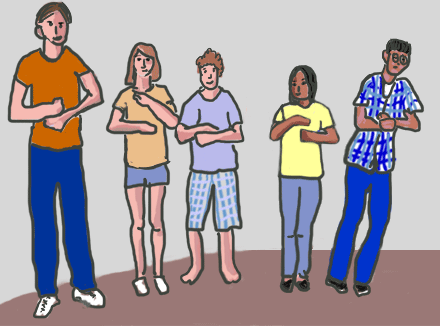
-On the phrase, “A ram sam sam” – Clap hands on your lap.
-On “Guli guli” – Spin hand over hand in a circle.
-On “A rafiq” – Hold hands apart miming that they’re pulling apart something gooey.http://actionsongsforyoungchildren.blogspot.com/2016/08/a-ram-sam-sam.html
The lyrics are :A ram sam sam, a ram sam samGuli guli guli guli guli ram sam samA ram sam sam, a ram sam samGuli guli guli guli guli ram sam samA rafiq, a rafiqGuli guli guli guli guli ram sam sam
A rafiq, a rafiqGuli guli guli guli guli ram sam samA Ram Sam Sam is a folk song originally from Morocco. The phrase “a ram sam sam” has no real meaning. “Guli” means “tell me/you say to me” in Moroccan Arabic. “ A rafiq” means “friend/travelling companions”. Its fun to coordinate actions with singing.
I do the following actions with the words, as learned during teacher training.
- “a ram sam sam”: Fists pounding, right over left, then left over right
- “guli guliguli guliguli”: spinning index fingers on either side of the head
- “a rafiq”: Pulling hands apart as if something is gooey



viet tv commentator quoted the following as if to remind the rhyme “ram” …
https://www.bbc.com/news/stories-46650911
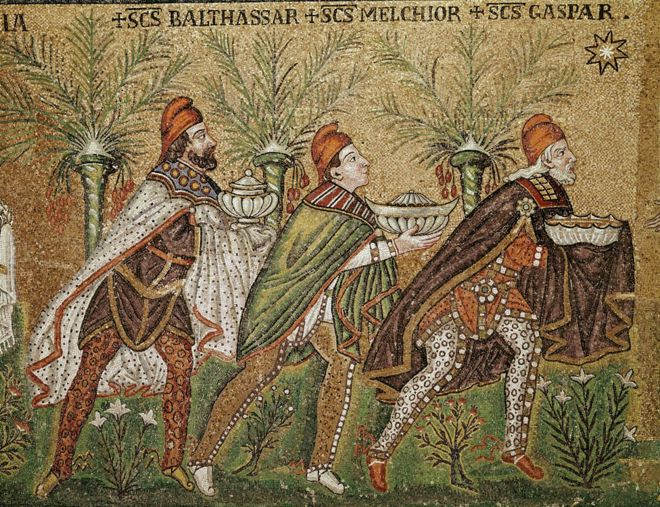
Were there more than Three Kings?
 Getty Images
Thirty years ago there were 50,000 Christians in south-eastern Turkey speaking a dialect of Aramaic – the language of Christ. Now there are 2,500. Talking to one of them, the BBC’s Jeremy Bristow learned that instead of Three Kings, there might actually have been 12.
Fresh out of his farm clothes, Habib the mayor now sits at his table in a crisply ironed shirt. He’s a gentle, almost diffident man in his early 50s, but he can form his letters with a calm assurance. He’s the custodian of a dying language.
Dipping his pen into the inkwell, he momentarily pauses, then starts to write. The broad nib moves right to left in neat black flicks and dashes, some vertical, some slanted, some horizontal, often with a deft flourish at the end. Sometimes Habib fashions a triangle, sometimes a circle, sometimes he adorns the shapes with a dot, indicating a vowel.
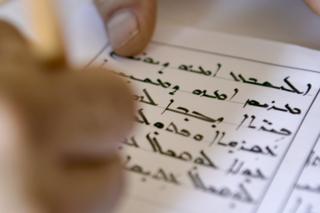
The script that is emerging before me looks like Arabic. It’s not… or not quite. It’s Syriac, a dialect of ancient Aramaic.
“Look, let me show you,” he says. “This letter is Olaf in our script, Alef in Arabic. See here, this letter is Lomad, it resembles Lam in Arabic. And He is Ha. Written together, they spell Aloho in Aramaic, the equivalent of Allah in Arabic. So many words from the Koran come from Aramaic.”
For 1,000 years, Aramaic was written and spoken right across Middle East. It was the language spoken by Jesus and his followers. The Jewish holy book, the Talmud, was written in Aramaic, and scholars say Arabic script is derived from it. But now, if Aramaic was an animal species, it would be declared critically endangered.
Habib, a Syriac Christian, is one of just 2,500 Syriacs who still live in this remote part of south-east Turkey. They call this region, their homeland, Tur Abdin. In Aramaic this means the Mount of the Servants of God.
How many Kings / Magi / Wise men?
- The Biblical source of the story of the wise men is the gospel of Matthew – Matthew doesn’t say how many there were, he just says they brought three gifts: gold, frankincense and myrrh
- St Jacob refers to 12 kings
- Michael the Syrian (St Michael the Great) names 11 kings: Dahdandur, son of Artaban; Shuf, son of Gudfar; Arshak, son of Mahduq; Zarwand, son of Warwadud; Aryo, son of Kasro; Artahshasht, son of Hamit; Ashtanbuzan, son of Shishron; Mahduq, son of Hoham; Ahshiresh, son of Sahban; Sardanh, son of Baldan; Marduk, son of Bel
- Melchior, Balthasar and Caspar belong to a different tradition
- All of the stories are thought likely to be legends
Once upon a time there was a flourishing Christian civilisation here. The landscape boasts hundreds of monasteries and churches – many now in ruins, many surmounted by mosques.
Take for example, Habib’s village of Hah, where he’s mayor, or Anitli as it is known in Turkish. A mere 20 Syriac families now live among the ruins of what was once a cathedral city with thousands of houses. Their homes are built among the remains of great buildings. Crumbling walls and giant archways loom above them.
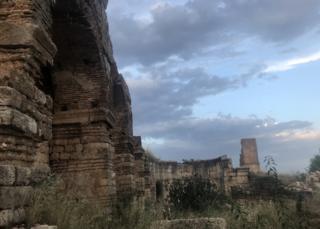
Six hundred years ago Hah was sacked by the armies of Timur the Lame, better known in English history as Tamberlaine. This was just one catastrophe in a long history of intermittent persecutions and occasional acts of terror that religious minorities like the Syriacs have had to endure in this part of the Middle East.
Habib’s family have survived by holding out in their fortress-like farmhouse that still stands above the village. Five other related families also live within this bastion, towering walls on the outside, farmyards within.
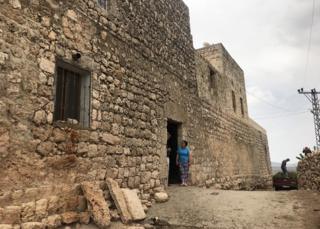
Habib says his family, the Beth Henno, have been here since records began. But so many Syriac Christians have left for Istanbul, for Sweden, Germany, Australia. In the last three decades they’ve been caught up in the brutal war between the Turkish state and the Kurdish Workers Party, the PKK. They’ve been threatened and driven out by both sides. In the 1980s 50,000 lived in Tur Abdin, now less than 5% of that number remain.
Habib and his wife, Leman, are doing their best to boost the numbers, raising seven children on their farm.
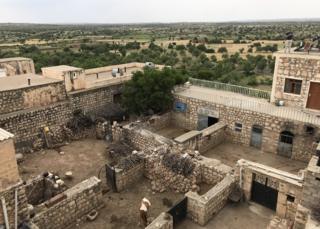
We walk down through the village, in the shadow of crumbling towers and gaping vaults, entering the courtyard of the Church of the Yoldath Aloho, the Mother of God. As I enter the nave I know I am standing in history. Is that the smell of ancient cement, or is it rotting plaster?
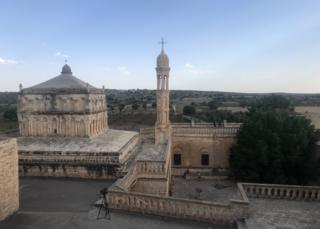
The walls and niches are covered in a riot of carved decorations covering arches that support a soaring octagonal dome. It’s here that Habib and the villagers still come to chant the hymns of Saint Ephraim, as their ancestors have done since the Church was built, nearly 1,500 years ago.
Find out more
- From Our Own Correspondent has insight and analysis from BBC journalists, correspondents and writers from around the world
- Listen on iPlayer, get the podcast or listen on the BBC World Service, or on Radio 4 on Saturdays at 11:30 BST
They will be here at Christmas. Habib tells me a local legend. Just over 2,000 years ago an auspicious star appeared in the night sky. Twelve kings from the East gathered here at Hah. A select three went on to Bethlehem bearing gifts to greet the newborn Christ. A grateful Mary, mother of God, gave them a piece of the baby’s swaddling clothes. When the three kings returned to Hah, the holy baby-wrap turned to gold. Awed by this miracle, the Kings founded this church.
As we walk back in to the courtyard, I hear the village children reciting, Aramaic in class. I ask Habib, what the future is for the Syriac community here in Tur Abdin, the Mount of the worshipers of God. “We won’t give up,” he says. “But I fear, in the end, we are too few.”
 stoppauseplayfastforwardrewindejectrecorddotnet